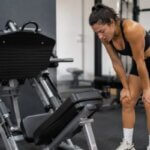
Feel dizzy after leg press can feel strange because you are seated, supported, and not doing a balance-heavy movement. The useful judgment is whether the dizziness comes from breathing pressure, blood-flow changes, standing up too fast, or a stronger warning sign that means the set should stop.
1. Feel Dizzy After Leg Press and the First Timing Clue
Feeling dizzy after leg press is not the same as feeling generally tired after a hard workout. The timing matters more than the exercise name itself. Some people feel lightheaded during the hardest reps, while others feel normal during the set and then get a head rush when they sit up or stand up from the machine.
Start by separating the pattern into three moments: during the push, immediately after the last rep, or when you get off the machine. Dizziness during the push often points toward breath-holding or pressure. Dizziness after standing up often points toward a blood-flow shift, especially after heavy lower-body work.
2. When the Machine Position Changes the Signal
The leg press lets you push hard while your body stays fixed in one position. That support can make the exercise feel safer, but it also makes it easier to use more weight, stay in the set longer, and build pressure without noticing. Your legs may be doing the visible work, but your breathing, blood pressure, and circulation are also reacting.
This is why leg press dizziness often feels sudden. You may finish the set, release tension, sit up, and then feel lightheaded, warm, weak, or slightly disconnected for a few seconds. In that pattern, the machine is not necessarily dangerous, but the combination of heavy leg effort and fast position change is too abrupt.
3. When Breathing and Pressure Start to Matter
Breathing is one of the clearest clues when leg press makes you lightheaded. During a heavy push, many people brace hard and hold their breath through the hardest part of the movement. A brief brace is normal in lifting, but holding pressure through most of the set can make the dizziness sharper when the set ends.
The pattern is more likely tied to breathing pressure if you feel head pressure, facial flushing, a tight throat, or a sudden rush after the final hard reps. This can happen even when your legs still feel strong. The set becomes a pressure event before it becomes a clean muscle-fatigue set.
If dizziness drops when your breathing stays controlled, the issue was probably set pressure, not leg strength. A useful test is to reduce the load slightly, slow the reps, and make sure you can breathe between repetitions.
4. When Standing Up After Leg Press Triggers a Head Rush
Dizziness when standing up after leg press deserves its own judgment. After a hard set, a lot of blood demand has been directed toward the working muscles in your legs. If you immediately sit up, unlock the machine, stand, and walk away, your body may not adjust fast enough.
This feels different from dizziness during the set. It often appears as a head rush, brief tunnel feeling, weak legs, or a need to grab the machine for a moment. Some people also feel faint after leg press only when they get up too quickly, not while they are actually pushing the weight.
The fix is not complicated, but it has to be deliberate. Stay seated for 30–60 seconds after hard sets, breathe normally, and stand up in stages instead of jumping off the machine. If you train alone, this matters even more because a brief head rush near heavy equipment can still lead to a fall.
5. When Dizziness Comes With Nausea or a Sick Wave
Sometimes leg press dizziness does not appear alone. It may come with nausea, stomach pressure, heat, burping, throat tightness, or the feeling that you need to stop before your legs are actually done. That is a different pattern from a simple standing head rush.
When dizziness and nausea show up together, check whether the set was too long, too close to failure, or done with rushed breathing. Heavy leg press can combine abdominal pressure, high effort, and lower-body blood demand quickly. In that case, the sick feeling may become the stronger signal than the dizziness itself.
If the sick wave becomes the main symptom instead of a brief head rush, compare it with Feel Nauseous After Leg Press: Pressure, Breathing, or Too Many Reps?
6. When the Problem Is Still Your Training Setup
Leg press dizziness is more likely a training setup issue when it only happens after very heavy sets, high-rep sets, short rest, or sets pushed too close to failure. In that case, your body is telling you the set exceeded your current tolerance for pressure and recovery speed. That does not mean you need to remove leg press completely.
Start by changing the smallest variable first. Reduce the weight, stop one or two reps earlier, extend rest time, and avoid standing up immediately after the set. If dizziness improves with those changes, the exercise can probably stay in your program with better control.
Use this order before treating the movement as a problem:
- Sit for 30–60 seconds after hard sets.
- Breathe between reps instead of holding pressure through the whole set.
- Stop before the final grinding reps.
- Reduce high-rep sets before removing leg press completely.
- Avoid drop sets until dizziness is no longer a pattern.
- Drink enough water before training, but do not overload your stomach right before leg work.
- Walk slowly after the set instead of rushing to the next exercise.
7. When Other Leg Exercises Show the Same Pattern
If dizziness happens only after leg press, the machine angle, heavy loading, and standing transition are the most useful places to adjust first. But if you also feel dizzy after squats, deadlifts, lunges, or other heavy lower-body work, the pattern is broader than one machine. That points more toward bracing, conditioning, recovery, fuel, hydration, or how hard your whole leg session is built.
This distinction matters because the solution changes. A leg-press-only problem may improve by changing seat position, load, breathing, and how slowly you get off the machine. A whole-leg-day pattern needs a wider look at rest periods, total volume, exercise order, and how often you push near failure.
If dizziness also happens during standing leg exercises, use this next comparison: Feel Dizzy After Squats: Breathing, Blood Pressure, or Warning Sign?
8. When It Is More Than a Normal Head Rush
A brief head rush after a hard leg press set can happen when effort, breathing, and standing up are poorly timed. It should settle after you sit down, breathe normally, and stop pushing the set. It should also become less frequent once you reduce the load, improve breathing, and stand up more slowly.
Stop the workout if dizziness comes with fainting, chest pain, unusual shortness of breath, severe headache, confusion, irregular heartbeat sensations, one-sided weakness, or symptoms that do not improve after resting. Those are not normal leg-day signals. They are reasons to stop training and get medical help.
Also take repeated dizziness seriously if it happens with light weights, warm-up sets, or every leg session despite changing your breathing and rest. That pattern should not be treated as proof that the workout is effective. It means the signal is no longer just about one hard set.
9. The Bottom Line
Feeling dizzy after leg press usually means the set created too much breathing pressure, blood-flow demand, or a sudden position change for your body to handle smoothly in that moment.
- Dizziness during the push often points to breath-holding or pressure.
- Dizziness after standing up often points to a fast blood-flow shift.
- Dizziness with nausea points more toward pressure, high reps, or pushing too close to failure.
- Dizziness that improves with slower standing, longer rest, and controlled breathing is usually a training setup issue.
- Dizziness with fainting, chest pain, unusual shortness of breath, confusion, or symptoms that do not settle is a stop signal.