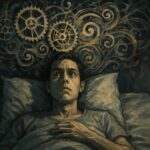
Can’t sleep after socializing at night can feel confusing because your body may be tired, but your mind still acts like the night is not over. The key is to separate normal post-social stimulation from anxiety-driven rumination, poor timing, or a sleep pattern that keeps repeating.
1. Can’t sleep after socializing at night: what is usually happening
After a night of talking, laughing, listening, reacting, and moving between people, your brain does not always switch into sleep mode immediately. Socializing is not passive rest. Even if the evening felt enjoyable, your nervous system may still be processing faces, tone, jokes, stories, and small moments from the night.
That is why this can feel different from ordinary insomnia. You may not feel worried at first. You may simply feel alert, mentally full, or strangely awake once you finally get home. The body is tired, but the brain is still sorting through stimulation.
This is usually normal when it happens after a long, exciting, emotional, or late social event. It becomes more of a problem when it happens after almost every social night, keeps you awake for hours, or leaves you drained the next day.
2. Social high or stress response: the first split to check
A social high feels like leftover energy. You may feel talkative, mentally bright, or tempted to replay the fun parts of the evening. Your thoughts move quickly, but they are not necessarily threatening. In this case, your brain is still activated because the night was stimulating, not because something is wrong.
A stress response feels sharper. You may replay what you said, wonder if you sounded awkward, regret small moments, or feel tense even though the event is already over. That pattern points more toward post-event rumination or social anxiety, especially if the same replay cycle happens after ordinary conversations.
If the thoughts feel energized but neutral, treat it like overstimulation. If they feel self-critical, tense, or hard to stop, treat it like rumination. That distinction matters because the solution is different. Overstimulation needs a cooling-down buffer. Rumination needs a way to close the mental loop before bed.
3. Why conversations keep replaying once the room gets quiet
Conversations often replay at night because there is finally no new input competing for attention. During the event, your brain keeps responding in real time. Afterward, especially in a quiet room, the leftover details can rise to the surface all at once.
This does not automatically mean you are anxious. Your mind may simply be reviewing social information because social interaction keeps the brain reading, responding, and adjusting in real time. That is a lot of cognitive load, even when the night was positive.
For broader nighttime racing thoughts, see Can’t Turn Your Brain Off at Night: Racing Thoughts, Stress, or a Sleep Problem?
The replay becomes more concerning when it turns into judgment. Repeating “that was fun” is not the same as repeating “why did I say that?” for an hour. The second pattern is more likely to keep the body in a guarded state.
4. Why being drained can still make you unable to sleep
Social fatigue does not always create immediate sleepiness. Sometimes it creates a strange mixed state: emotionally drained, physically tired, but mentally alert. This happens because fatigue and sleep readiness are not the same thing.
Some people also feel an emotional crash after socializing, where they feel drained, exposed, or mentally flat, but still too wired to sleep. In that state, the problem is not a lack of tiredness. The problem is that your nervous system has not fully stepped out of social mode.
You can be tired from stimulation while still too activated to fall asleep. Bright rooms, loud conversations, late meals, alcohol, caffeine, emotional topics, and constant attention can all keep your nervous system above its usual bedtime level. When you get home, the event is over, but your body has not fully downshifted.
This is why going straight from social mode to bed often fails. Your brain has no transition. It is like closing a laptop while a dozen tabs are still running in the background.
If the night ended in crying and wired exhaustion, read Can’t Sleep After Crying: Why Your Body Feels Tired but Sleep Still Won’t Come.
5. When it is normal and when it is becoming a pattern
It is usually normal if you struggle to sleep after an unusually late, intense, or exciting night. One poor night after a party, dinner, date, event, or long conversation does not mean you have insomnia. Your sleep system may simply need more time to settle.
It is more of a pattern if it happens after mild socializing too. If a casual dinner, short meetup, or ordinary phone call regularly keeps you awake, the issue is not only the event itself. Your brain may have learned to associate social interaction with nighttime alertness, evaluation, or delayed sleep.
Use this simple split:
- Normal: it happens mainly after late, loud, exciting, or emotionally intense nights.
- Watch closely: it happens after most social contact, even when the evening was calm.
- Problem pattern: it causes repeated next-day exhaustion, dread before social plans, or avoidance because you fear losing sleep.
6. What to do before bed instead of forcing sleep
The worst move is usually forcing sleep immediately. Lying in bed while your brain is still socially activated can train your bed to feel like a place where thoughts keep running. A short buffer works better than trying to shut everything down instantly.
Start with a low-stimulation transition. Keep lights dim, avoid social media, and do something that does not invite more conversation or emotional input. A boring physical book, simple stretching, a shower, or quiet tidying can work because the goal is not entertainment. The goal is to signal that the social part of the night is over.
If your mind is replaying conversations, do a quick brain dump. Write the main thoughts in plain language, not as a journal entry you keep expanding. The point is to move the loop out of your head, not analyze the entire night. Then stop. More analysis usually keeps the system awake.
7. What to avoid after a social night
Avoid checking messages right before bed. One reply can restart the social loop, especially if the conversation was emotional, exciting, or unclear. Even a harmless notification can make your brain feel like the night is still active.
Avoid replaying the event as a problem to solve. If you keep asking whether you acted normal, sounded awkward, or said the right thing, your brain treats the memory as unfinished business. That keeps alertness high.
Also avoid using bed as the place where you process the night. If you need to decompress, do it before getting into bed. Bed should be the final landing point, not the place where the social event continues in your head.
8. When the issue may be social anxiety, not just overstimulation
Social anxiety is more likely when the sleeplessness comes with self-monitoring. You may replay your tone, facial expressions, pauses, jokes, or small awkward moments. The memory feels like evidence you need to inspect, not just a scene your brain is reviewing.
Another sign is anticipatory worry. If you start worrying before social plans because you expect to be awake afterward, the sleep problem and the social worry may be reinforcing each other. The event triggers rumination, rumination delays sleep, and poor sleep makes the next social event feel harder.
This does not mean every post-social sleep problem is anxiety. The difference is emotional charge. Overstimulation feels busy. Social anxiety feels evaluative.
9. How to judge the next morning
The next morning gives useful information. If you feel a little tired but recover after a normal day, the night was probably a temporary overstimulation issue. Your system was delayed, not broken.
If you wake up exhausted, foggy, tense, and still replaying the event, the issue deserves more attention. That means the night did not fully resolve during sleep. Your brain may have carried the social stress into the next day.
Track the pattern, not one night. A single bad night after socializing is not enough to label it a sleep problem. Repeated nights after ordinary social contact are more important.
10. Key takeaway
Can’t sleep after socializing at night is usually a sign that your brain needs a transition period, not proof that something is wrong with your sleep. The problem starts when social stimulation repeatedly turns into rumination, anxiety, or next-day exhaustion.
The main question is not whether socializing is bad for sleep, but whether your brain is simply energized or stuck in evaluation mode.
Key judgment:
- If the night was late, exciting, loud, or emotional, delayed sleep is usually normal.
- If your thoughts feel energized but not threatening, treat it as overstimulation.
- If your thoughts become self-critical or repetitive, treat it as rumination.
- If this happens after most social contact, build a stronger post-social wind-down routine.
- If it causes avoidance, severe anxiety, or repeated sleep loss, take the pattern seriously.